Adaptive Reuse of Built Assets
A model policy on repurposing existing buildings and assets to extend their lifespan (2024).

Whole Life Carbon Assessment (WLCA)
A model policy to create WLCA legislation and policies for major developments (2023).

Adoption Playbook for Whole Life Carbon
A playbook supporting the adoption of WLCA policy and overcoming challenges (2024).

Practitioners Guide to Whole Life Carbon
A guide for practitioners on ways to comply and prepare for WLCA implementation (2024).
Reducing Embodied Carbon in Cities
A white paper on nine solutions for enabling greener buildings and communities (2024).
Decarbonization of Buildings
A briefing paper about the 'building value framework' for shifting how value is defined and perceived (2022).
Green Buildings Principles
An insight report providing steps to deliver net-zero carbon real estate portfolios and guidance on implementation (2021).
Net-Zero Carbon Cities - Energy
An insight report recommending an integrated energy approach as a solution, defined as systemic efficiency (2021).
CEO Briefing: Financing the Transition in Cities
This briefing articulates the arguments for why financial institutions must take action on nature.
Nature Positive: Financing the Transition in Cities
An insight report making the financial case for nature solutions and provides guidelines for city and business leaders (2025).
Nature Positive: Guidelines for the Transition in Cities
An insight report for regenerating nature in cities with guiding frameworks and tools to support decisions (2024).
Nature Positive: Leaders' Insights for the Transition
An insight report highlighting success stories of weaving nature into urban life and offers scalable solutions (2025).
Cities’ Efforts to Advance the Transition – Barranquilla
Barranquilla, one of Colombia’s fastest-growing cities, is redefining urban development by investing over $380 million in green infrastructure, renewable energy and water management (2025).
Cities’ Efforts to Advance the Transition – San Francisco
San Francisco is leading the shift towards ecological resilience by embedding nature into city planning through partnerships, community engagement and standardized data systems (2025).
Cities’ Efforts to Advance the Transition – Durban
The City of Durban and the eThekwini Municipality are enhancing partnerships and initiatives, structures, and plans to halt and reverse nature loss by 2030, while maximizing its economic and social potential (2024).
Sector Transitions to Nature Positive
These insights are also part of the Nature Positive Transitions series that informs sectoral approaches for business, guides the financing sector, and helps cities reconcile their relationship with nature, while aligning with the Global Biodiversity Framework.
Business on the Edge: Building Industry Resilience to Climate Hazards
An insight report exploring climate hazards, showing how heat and flood threaten corporate fixed assets with potentially annual earnings losses of 6.6%–7.3% by 2035, and offers a roadmap for progress (2024).
Resilient Economies: Strategies for Sinking Cities, Infrastructure and Flood Risks
An insight report highlighting the pathways for addressing compounding risks from land subsidence and extreme weather event to built infrastructure, economic and societal resilience (2025).
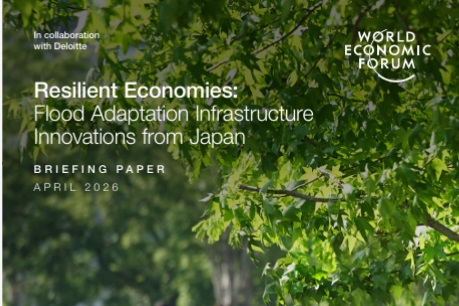
Resilient Economies: Flood Adaptation Infrastructure Innovations - Japan
A briefing paper on infrastructure innovations across urban-rural areas of Japan, enabling immediate and long-term adaptation and building resilient to increasing flood risks (2026).
From Wildfire Risk to Resilience: The Investment Case for Action
A white paper presenting a framework for shifting towards prevention-focused, long-term wildfire resilience by making risk reduction measurable, priceable and financeable (2026).
Delivering Climate Resilient Cities Using a Systems Approach
An insight report providing cities with an actionable strategy to take a systems approach to climate resilience strategies. It provides a 5-step action plan to guide cities in adopting a systems approach to urban infrastructure delivery (2022).
Resilient Firms and Economies: How to Help Unlock Growth in Emerging Markets
A white paper examining how coordinated actions can turn resilience challenges into sustainable growth, as only one in four companies feel prepared across resilience dimensions (2025).
Resilience Pulse Check: Harnessing Collaboration to Navigate a Volatile World
A white paper on how businesses are responding to today’s challenges, with insights from over 250 leaders across industries and regions (2025).
Building a Resilient Tomorrow: Concrete Actions for Global Leaders
A white paper showcasing pioneering initiatives from public and private organizations with concrete actions to promote resilience and identify opportunities for collaboration and investments (2024).
High-quality built environment and infrastructure


Connects People

Protects the Environment

Follows Good Governance
Improves Sense of Place
Fits the Purpose
Results in Spatial Coherence
Is Beautiful